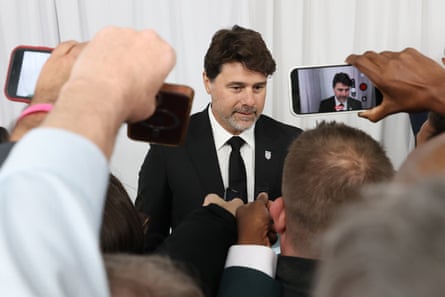
The draw is done. The schedule is set. For the US men’s national team, all that’s left, aside from playing the games, are the emotional highs and lows. After the draw, US head coach Mauricio Pochettino referenced a “competitive stress” factor triggered by the World Cup. He said the friendlies against Belgium and Portugal in March are intended to simulate that stress so that it doesn’t surprise his players when the spotlight of the World Cup arrives.
With the margins always thin at a World Cup, earning results that mitigate that pressure could prove to be the difference between the USMNT crashing out just when they capture the undivided attention of the nation, or enduring and soaring to a best-ever finish.
The preparation
Stress can seep into the emotions of a team well before the World Cup. Former US captain Landon Donovan, a veteran of three World Cups, described an excitement that’s “very palpable and different” when the squad convenes for a World Cup camp, but acknowledged “it also depends on where you are in the pecking order.”
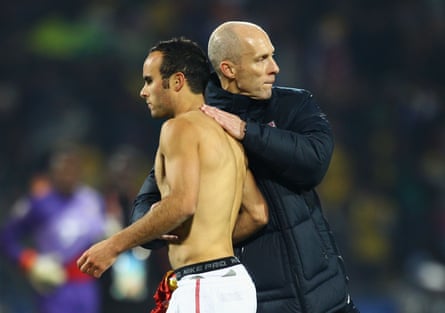
Head coach Bob Bradley had clearly conveyed to his core where they stood during the 2010 cycle, which included not just qualifiers but also the now-defunct Confederations Cup in 2009.
“He had pulled us into a room a year prior [to the World Cup], about 15 of us, and said, ‘Guys, you are the 15 who are going to be there for sure,’” Donovan told the Guardian. “And over the next year, three or four more probably solidified their spot. But then there were three to six spots that were still up for grabs. Mentally, for guys who knew they were going and who were going to be contributors, it’s all about preparation. But there were other guys who were very much competing for their spots, and so everything was at stake every day.”
Before the 2010 World Cup, 30 players were summoned to Bradley’s alma mater, Princeton, for camp. The first send-off friendly against the Czech Republic was the last audition for a lot of nervous players to make the 23-man squad.
“When all is said and done, the hardest part is going from 30 to 23 [for the World Cup squad] in a short amount of time,” Bradley told the Guardian. “Would [I] do that exactly the same? I don’t know. You had certain decisions that had to get made. You needed to see certain guys up close, but there’s a lot of pressure, and guys felt that.”
Pochettino has hinted that only the 26 players on the 2026 tournament squad will be heading to the new US Soccer national training center in Atlanta ahead of the World Cup.
“I think from the beginning, if you say, ‘OK, that is the 26,’ that is a shock, but [eventually] you accept [it],” Pochettino said. “But after being involved and then that’s it, go home, I think it’s more cruel.”
There’s also simply less time for late tryouts, with Pochettino’s pre-World Cup camp shorter than previous runways to the summer version of the tournament. They’ll be assembling on 27 May, with two friendlies instead of three. But it’s not quite as condensed as the preparation for World Cup in 2022, when most of Berhalter’s squad flew straight from Europe to Qatar.
“It was a surreal feeling,” left-back Antonee Robinson said. “I can kind of remember the whole experience, going straight from the [Premier League] game with [Fulham teammate] Tim Ream straight to the airport and getting on the plane. And when we land in Qatar, that’s when the reality sinks [in]. ‘We’re actually here now.’”
The USMNT had plenty of talent at Europe’s top clubs for the 2022 World Cup, but also boasted the tournament’s second-youngest roster.
“No matter how much experience you have, when you play in a World Cup, it’s a different type of game,” Berhalter said. “And I’ll never forget the conversation with Yunus [Musah] after the Wales game, he was like, ‘Oh my God, this felt like a final of a tournament.’ That’s how intense the game was, and it’s exhausting. It’s physically exhausting, mentally exhausting, but that’s what the World Cup is.”
The group stage
There wasn’t a shortage of World Cup experience with Bradley’s squad in 2010, but Donovan was the only one set to start at his third straight tournament. In his World Cup debut in 2002 the US stunned Portugal 3-2, and eight years later they were set to face England in the World Cup opener.
“I knew that the difference about a round robin World Cup tournament is that every goal is crucial, which means every play is crucial,” Donovan said. “We weren’t expected to win the [England] game – but we were confident that we were a team capable of beating them.”
However, captain Steven Gerrard gave England the lead in the fourth minute.
“I knew the chances of qualification [for the knockout round] go down significantly if you lose your first game,” Donovan said. “And so the pressure was on to get something out of the game.”
The US were gifted an equalizer by England goalkeeper Robert Green and held their own to secure a point, but the pressure mounted even more in their second group game against Slovenia after conceding two first-half goals.
“When we got to half-time and we were down two, that was a key moment for that group. We knew we needed to get one or three points. Other than that, we’re out,” Bradley said.
Less than three minutes after the break an authoritative Donovan strike cut the deficit in half. In the 82nd minute Michael Bradley tied it at 2-2. And a few minutes later, Maurice Edu buried a Donovan free kick to complete an exhilarating comeback win … but the goal was inexplicably disallowed.
And in the group finale against Algeria, the pressure would keep climbing until second half stoppage time, when Donovan’s game-winner became the most famous moment in USMNT history. The win, though exhilarating, brought other issues.
The regroup
After Donovan’s viral moment, the US had just three days to mentally reset and prepare for Ghana in the next round.
“It’s really hard,” Donovan said. “It’s one of the hardest things in sports, and one of the least talked about things in sports. Of course there was a physical drain, but the emotional drain, it’s hard as a human, even as a trained athlete, to get yourself up again after such an emotional game … When you win a game in that fashion, it’s hard not to sort of let your guard down a little and feel relief. And so even immediately after the game, we’re in the locker room having a beer with President Clinton… it’s hard not to get caught up in the moment. And candidly, I’m glad we got caught up in the moment. That was one of the best few hours of our lives.”
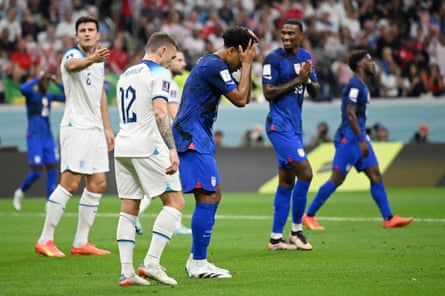
The 2022 team faced its own tense conclusion to the group stage. Although they hadn’t trailed yet in Qatar, three points slipped away late in the opener against Wales when Gareth Bale drew then converted a penalty kick. The US then held their own in another marquee group matchup with England, earning a point.
“The England game was a very strong performance, but all it did was put us in position,” Berhalter said. “It was precarious. Iran, all they needed was a tie [against us], and they’re through.”
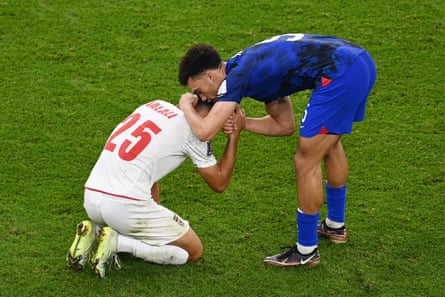
In the end, Christian Pulisic’s 38th-minute goal against Iran was enough. The US held on for three points in an extremely tense finish.
“We had a real few close calls in the match where Iran nearly equalized with us. And then on the flip side of it, that was why I was like so consoling to their players,” Robinson said. “Throughout the course of the World Cup, I had had some family things going on which was kind of why I was emotional anyway … the joy of the fact we’d actually got through, I did my ankle in that game, so the pain I was feeling, that was all swirling around at the same time and it busted me up a bit.”
In 2010, with qualification secured, Bradley leaned on longtime US Soccer administrator Tom King to surprise the team by bringing their families – who were staying 20 minutes away – to celebrate at the team’s home base. Similarly in 2022, following the win over Iran, Berhalter gave his team the next day off to spend time with their families. It would be a much-needed rest before the stresses to come.
The knockout round
Berhalter acknowledged that the Iran match “took a toll on the guys mentally” and the Round of 16 clash with the Netherlands “came really quickly.” The US benefited from a state-of-the-art recovery and medical setup along with a meticulously planned player lounge which Berhalter had fundraised for. But emotionally, they could only absorb so much.
“We didn’t have that edge, and I don’t think we had it because there was an emotional toll that the World Cup took on the group, and we weren’t really prepared for that over time,” Berhalter said.
Berhalter also points to the Netherlands’ extensive experience performing in big moments; a big contrast to his upstart US squad.
“The guys were ready to play. But you have to understand that there’s a difference between playing well, and eliminating Holland in a World Cup knockout stage,” Berhalter said. “The coach has been there before, the team has been there before. These weren’t World Cup rookies, and they had the edge.”
Bradley believed his 2010 team were built for the psychological strain in South Africa, noting their high-profile friendlies during the cycle, plus their run to the Confederations Cup final the previous year.
They weren’t fazed when they fell behind in the fifth minute against Ghana.
“We used an expression sometimes, ‘play it on the edge,’ where you got to go for it, because now you’re behind or whatever,” Bradley said. “And we had experiences in those kinds of games where we knew how to push a game.”
The US equalized with a Donovan penalty kick, but were eliminated in extra time.
The expectations
In both 2010 and 2022, the US arguably met expectations by advancing to the knockout round. But there is still disappointment, some of which is natural for any tournament exist, and some of which is rooted in the United States’ continuing quest to establish themselves among the world’s best sides.
Robinson noted that the US had knockout experience and success in Concacaf, but face the challenge of translating it to a bigger stage.
“We can’t lean on the fact that we’ve done it before,” he said. “It’s been a long, long time, and the players in our squad haven’t done it, but we’re just going to have to try and get into that mental gear of expecting ourselves to be able to win knockout games and go in with true belief that would go into [it] because if you turn up to the tournament and you don’t truly believe that you could actually go far and win the whole thing, then you’re putting yourself at a massive disadvantage to everyone else.”
Donovan also underlined the importance of setting the bar higher than it has traditionally been in US soccer.
“My opinion is that it boils down to expectations, and when we get to a point where we expect to get to a quarter-final or a semi-final or a final, like probably 8-10 other teams in the World Cup will be doing next summer, there’s a mentality piece where you’re not just satisfied to get to a certain point. You want to keep going,” Donovan said. “Everybody, of course, wants to keep going. But when we got to the quarter-finals against Germany in 2002, from an expectation standpoint we had already exceeded it. And so it was almost playing with house money.”
The expectations for those top international teams are, of course, primarily a function of their quality. While the US has not yet ascended to that tier of talent, they could get a boost from hosting the tournament in 2026. Berhalter highlighted Morocco in 2022 and Korea in 2002 as replicable examples of momentum and favorable crowds carrying those teams further than what seemed possible on paper. Robinson stressed that at a World Cup in particular, the game is not decided on paper.
“It doesn’t always come down to who’s the best team, it comes down to which team wants to win more,” he said. “So making sure that we have our themes of how we want to play in the background, but the overarching theme is going to be we have to compete more, we have to fight more than the other team, and if we win that battle, then [I’m] hoping that our quality of the team shines through after that.”
That will apply, first and foremost, to the group stage, where the US are favored. Friendly wins against Paraguay and Australia previewed the intensity of their World Cup meetings, featuring literal fights and hard tackles.
“They were friendlies, but also they weren’t very friendly,” Tim Ream said after the draw. “And now you add in the heightened aggression and experience of a World Cup, and they’re all finals, they all mean something now. Everything is going to be ramped up exponentially.”


 The Truth Media





 The Truth Media