For a brief period in the early 2000s, Scandinavian clubs seemed unstoppable in European women’s football. Umeå lifted the Uefa Women’s Cup in 2003 and again in 2004, using a blend of technical skill and tactical intelligence. The Swedish side were a powerhouse and attracted top talent from around the world, including Marta, widely regarded as the greatest ever female player.
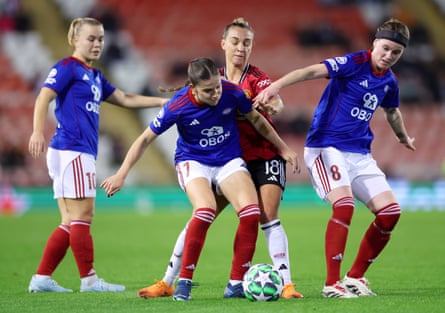
That dominance feels very distant. In 2025, a Norwegian, Swedish or Danish club winning the Women’s Champions League is almost unthinkable. Vålerenga were the only Scandinavian team to reach the Champions League league stage this season and they did not qualify for the knockout phase.
The decline has not been sudden but the gap between the Nordic leagues and Europe’s elite has widened steadily as investment, infrastructure and commercial power have concentrated elsewhere.
At Vålerenga, the limitations are visible at every level and Harriet Rudd, the club’s chief executive, is clear about the economic realities. “The football economy in Norway is much smaller,” she says. “Norway is not a country where you have a lot of very, very big investors or big men’s clubs who can afford to fund women’s clubs, which are operating at a deficit over many years.”
As women’s football across Europe has professionalised, many Scandinavian clubs that were independent havegone under the umbrella of their male counterparts to ensure financial security. For Vålerenga, this decision was made at the start of the 2010s. Integration has brought stability but it has not delivered the level of sustained investment now seen in the Women’s Super League or among other leading clubs in Europe.
Steinar Pedersen, Vålerenga women’s sporting director, joined the club in 2022. He regards the talent movement as inevitable and necessary for the growth of Norwegian players and an unavoidable feature of the modern game. “It’s very natural that we have the best Norwegian players playing abroad,” he says. He also stresses that European competitions remain crucial, even when Scandinavian clubs struggle to go far. “European competitions remain vital to the game’s development. More clubs being able to participate in the Europa Cup is good. It’s a learning process for the players, competing against players from different cultures, teams and leagues. But again, there are significant differences between countries and how far they have come.”
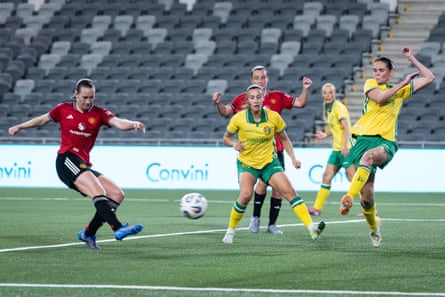
The Swedish side Hammarby, who this week lost Julie Blakstad to Tottenham at the end of her contract, were eliminated by Manchester United in the Champions League playoffs, losing 1-0 in Stockholm. The main differences between Scandinavian and WSL clubs are in finances and infrastructure. Markus Nilsson, the deputy CEO of Hammarby, said he would welcome a slightly different approach from the Swedish Football Association. Most of the initiatives run by the Swedish FA – such as #InYourName, All Days, and The Coach Lift – are aimed at promoting gender equality in football, especially at grassroots level.
Nilsson wants more direct investment in the elite game. “The league organisation and the Swedish FA are the same on the men’s side. On the women’s side I think the FA expects the league organisation to address all questions regarding the two top leagues. But I would love to see that the Swedish FA also actually did some investments for the top talent or top leagues and not only working on the grassroots level.”
Nilsson, however, points to future commercial opportunities that could reshape the league. “In the next five to six years, we need to find a place where the business model around the women’s team is actually profitable,” he says. “I think mainly when the transfer market is growing, meaning that the big clubs in WSL, for example, will need to spend more money in terms of player transactions. So I think that’s the biggest kind of opportunity in the future.”
Player development remains critical to bridging the gap and is a key focus of the Scandinavian league model. Christian Lundström, the director of women’s football at Häcken, is candid about the challenges. “It’s taking time to develop players,” he says. “It’s essential to develop players because we are not at the top of the chain. So players will go abroad and then we need to develop new players.”
Häcken have embraced their role as developers of world-class talent and players such as Stina Blackstenius, Anna Sandberg and Johanna Rytting Kaneryd have joined the WSL from the Gothenburg club. In the past couple of weeks, Alice Bergström has moved from Häcken to Liverpool and Matilda Nildén and Hanna Wijk have left for Spurs.
Lundström emphasises the importance of investing early. “It’s an essential thing to start now and to focus on building academies,” he says. “It is not a problem to get young players to play in the top league. That will stimulate them. But the most important factor in a player’s development is training. How they train and what to learn in training. So, good coaches are down in the academies at a young age and all the way up, so they have an excellent education.”
Nils Nielsen has more experience than most when it comes to Scandinavian and English women’s club football, having been the national coach in Denmark as well as the first director of women’s football at Manchester City. He has a unique perspective on investment, facilities and player development and says the biggest difference was in facilities. “At City we had everything within our grounds,” he says. “It was all available for us and the expertise [in different roles] was available.”
The Dane highlights a key philosophical difference. “In England, the investment came first and the results followed,” he says. “In Denmark, people were often asked to deliver results with no funding. I don’t think it [the English way] will be very hard to replicate. I hope other countries will look at that and say: ‘OK, maybe we should stop asking people to deliver results with no funding, give them the funding first,’ because that would help a lot.”
Nielsen recalls the obstacles he and his Denmark team faced. “We banged our heads against the wall many times when we were asking for more,” he says. “We got a little bit, then they hoped we would be quiet for the next year. But we couldn’t be because we were missing so many things.”
Despite these challenges, Nielsen is optimistic. “I see a bright future where [women’s football] will become bigger and bigger in the countries that have already invested,” he says. “And those who have to invest now need to make a decision. Do we want it, or don’t we? Because if they do it half-hearted, they are never going to reach what they want to reach.”
It feels fair to say that Scandinavian women’s football will probably never dominate Europe again, but it is likely to remain a key part of the development of players. Clubs will need to adapt to their reality within the football ecosystem and whether that evolution leads to renewed competitiveness will depend on whether the ambition is there.
This is an extract from our free email about women’s football, Moving the Goalposts. To get the full edition, visit this page and follow the instructions. Moving the Goalposts is delivered to your inboxes every Tuesday and Thursday.


 The Truth Media








 The Truth Media